How to Calculate Home Replacement Cost

Table of Contents
- Understanding Replacement Cost vs. Market Value
- Key Factors That Influence Your Home's Rebuild Cost
- Step-by-Step: How to Calculate Your Dwelling Coverage Limit
- Using a Homeowners Insurance Replacement Cost Estimator
- DIY Assessment vs. Professional Appraisal
- Getting Fast Home Insurance Quotes Online
- Protecting Against Underinsurance and Coverage Gaps
- Frequently Asked Questions
Last Updated: September 28, 2026
Understanding Replacement Cost vs. Market Value
Home replacement cost is what it would take to rebuild your home from the ground up if it were completely destroyed. Market value is what someone would pay for your house as it stands today, land, condition, location, all included.
A house on valuable land might sell for $500,000 but cost only $350,000 to rebuild. Conversely, a custom home in a rural area might cost $600,000 to rebuild but sell for $400,000 because land value is lower.
This distinction matters enormously for insurance. Your homeowners policy protects the structure itself, not the land value. If your house burns down, the insurance company rebuilds the house, not the land. That's why calculating your dwelling coverage based on replacement cost, not market value, is the only way to avoid being underinsured.
Key Factors That Influence Your Home's Rebuild Cost
Rebuild cost depends on local building codes, construction materials, labor rates, and site-specific conditions, not just square footage.
Building materials and quality matter most. A basic frame house costs far less to rebuild than a custom stone-and-timber home. Roofing material alone, asphalt shingles versus slate, can swing costs by thousands.
Regional labor and material costs vary sharply. Contractors in rural areas charge less than those in major cities. Material prices also vary by region due to supply chain and demand.
Square footage is a starting point, not the whole story. A 2,000-square-foot ranch costs less per square foot than a 2,000-square-foot colonial with complex rooflines. Foundation type, bathrooms, basement finish, and architectural complexity all affect per-square-foot cost.
Local building codes and permits add hidden costs. Some municipalities require expensive upgrades like updated electrical systems, seismic reinforcement, or energy-efficient windows. Permit fees and inspection costs vary by location.
Site preparation and debris removal are real expenses. If your home is destroyed, the contractor must clear the lot, remove rubble, and prepare the foundation. On difficult terrain or with poor access, this step alone can cost thousands.
Step-by-Step: How to Calculate Your Dwelling Coverage Limit
The most straightforward approach uses a per-square-foot estimate, then adjusts for your specific situation.
Step 1: Find your home's square footage. Check your property deed, tax assessment, or a recent appraisal. Use the finished square footage, don't count the garage or unfinished basement unless those spaces are heated and finished.
Step 2: Research local rebuild costs. Contact local contractors or visit the National Association of Home Builders website for regional per-square-foot estimates. Costs typically range from $150 to $300+ per square foot depending on region and quality.
Step 3: Multiply square footage by the per-square-foot rate. If your home is 2,000 square feet and local costs are $200 per square foot, your base rebuild cost is $400,000.
Step 4: Adjust for your home's specific features. Add costs for custom finishes, high-end materials, or complex rooflines. Subtract if your home is very basic. Adjust 10-20% up or down from the base number.
Step 5: Add site costs. Include debris removal, permits, and site preparation. Budget an additional 10-15% for these line items.
Step 6: Round up slightly. Construction costs rise. Add a small buffer, 5-10%, to account for inflation and unexpected conditions discovered during rebuilding.
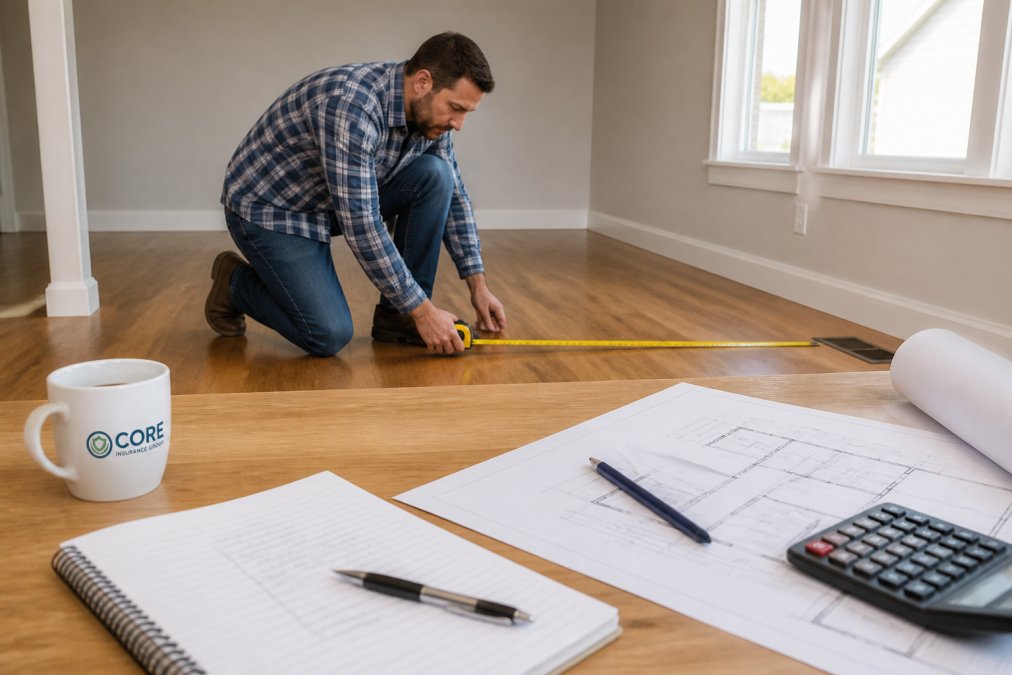
The result is your estimated replacement cost. This becomes the baseline for your dwelling coverage limit.
Using a Homeowners Insurance Replacement Cost Estimator
Replacement cost estimators range from simple online calculators to detailed professional appraisals. Each type serves a different purpose and produces different levels of accuracy.
Online calculators: Fast but surface-level. Free web-based tools ask for square footage, location, year built, bedrooms, bathrooms, and construction type, then cross-reference against a cost database. They're useful for a quick ballpark figure but lack specificity and can't account for custom finishes or site conditions. Most have a 15-25% margin of error. Use them as a starting point, not a final number.
Insurance company estimators: Tailored to underwriting standards. Insurers run their own replacement cost calculations using proprietary data and claims history. They may ask about roof condition, HVAC age, renovations, or special features. Estimates vary significantly between insurers due to different cost assumptions. Request quotes from three to five insurers to establish a range and spot outliers.
Professional appraisals: Detailed and defensible. A licensed appraiser visits your home, measures rooms, documents materials, inspects systems, and reviews local codes. They produce a written report with line-item cost breakdowns. Professional appraisals eliminate guesswork and give you access to local contractor rates and code requirements that calculators miss. They're especially valuable for custom homes, unusual construction, or volatile-cost locations. An appraisal also creates a documented record that strengthens your position if a claim is disputed.
How to choose the right estimator. Start with an online calculator or insurance quote for a baseline. If your home is a standard ranch or colonial in typical condition, that estimate is usually sufficient. If your home is custom-built, has high-end finishes, unusual architecture, or sits in a volatile-cost location, invest in a professional appraisal.
DIY Assessment vs. Professional Appraisal
You can gather useful information yourself, but the question is whether you should rely on it for your final coverage decision.
When DIY assessment is adequate. A DIY approach works if your home is standard construction (wood-frame ranch, colonial, or split-level), built within the last 30 years with common materials, in good condition, typical size for your region, and you're comfortable with a 10-15% margin of error.
Document your home's square footage, bedrooms, bathrooms, roof material and age, siding type, and significant features. Call three to five local contractors for their per-square-foot rebuild rates for your home type and quality level. Cross-reference with online estimators. Calculate: square footage × per-square-foot rate. Adjust 10-15% up for custom features or down for basic construction. Add 10-15% for permits, site preparation, and debris removal.
When DIY assessment is insufficient. Do not rely on DIY assessment if your home is custom-built, historic, built before 1980, has high-end finishes, is significantly larger or smaller than typical homes in your area, or if you're uncertain about materials or system ages. A professional appraisal is the safer choice in these cases.
The liability and accuracy trade-off. A DIY estimate is free and takes a few hours of your time. It's based on your own observations and local contractor input, which can be accurate for straightforward homes. However, it has no third-party verification. If you underestimate and later file a claim, the insurer may question your coverage limit. A professional appraisal costs $300-$600 but produces a documented, defensible estimate. An appraiser has access to detailed local cost data, understands building code impacts on rebuild cost, and can identify features you might overlook. If a claim becomes disputed, a professional appraisal strengthens your position. For high-value homes or complex properties, the upfront cost of an appraisal is insurance against the much larger cost of underinsurance.
A hybrid approach. Many homeowners start with a DIY assessment to establish a rough baseline, then request quotes from two or three insurers. If those quotes cluster within 10-15% of each other and align with your DIY estimate, you have reasonable confidence. If quotes vary widely or differ significantly from your DIY number, that's a signal to hire a professional appraiser to resolve the discrepancy.
Getting Fast Home Insurance Quotes Online
Once you've estimated your replacement cost, you can shop for homeowners insurance quickly online.
Start with your current insurer. If you already have a policy, request a quote for updated dwelling coverage based on your new replacement cost estimate. Existing customers often get faster quotes and may qualify for loyalty discounts.
Use comparison websites. Sites that aggregate quotes from multiple insurers let you enter your home details once and receive estimates from several companies.
Protecting Against Underinsurance and Coverage Gaps
Underinsurance happens when your dwelling coverage limit falls short of actual replacement cost. If your home burns and costs $450,000 to rebuild but your limit is only $350,000, you're $100,000 short. Insurance won't cover the gap.
Frequently Asked Questions
What is the formula for calculating home replacement cost?
There is no single universal formula, but the basic approach is: square footage × per-square-foot rebuild cost + site-specific factors = replacement cost. Start by determining your home's total square footage, research local per-square-foot construction costs (typically $100-$300 depending on quality and region), then adjust for factors like foundation type, roofing materials, custom finishes, and local building codes. This gives you a working estimate before professional appraisal.
How does replacement cost vs. market value affect my insurance coverage?
Replacement cost is what it takes to rebuild your home from scratch; market value includes land and is what you'd sell the property for. Insurance dwelling coverage is based on replacement cost, not market value. Your home may sit on valuable land but have modest rebuild costs, or vice versa. Understanding this distinction ensures you set your dwelling coverage limit correctly and avoid underinsurance.
How often should I update my home replacement cost estimate?
Update your estimate annually or after major home improvements, and always when inflation or regional construction costs shift significantly. Labor rates and material prices fluctuate, and your home's condition changes over time. Many insurers offer inflation guard endorsements that automatically adjust your dwelling coverage limit year to year, reducing the need for manual recalculation.
What factors increase the replacement cost of a home?
Custom finishes, high-end building materials, complex roof designs, foundation type, local building codes, and site preparation all raise rebuild costs. Homes with premium fixtures, stone or brick exteriors, or intricate architectural details cost more to replace than basic construction. Regional labor rates and material availability also matter, costs vary significantly by location. Professional appraisals account for these details.
Want this checked against your own policy?
We compare 100+ carriers and tell you what actually changes.