
7 Alternatives to Standard Home Insurance for Older Homes

Quick Summary
Homeowners with older homes can look beyond standard insurers to state FAIR Plans, surplus lines carriers, and dwelling fire policies. Each option covers different risks, so compare coverage limits, settlement methods, and exit conditions before choosing. Replacement cost coverage usually protects older homes better than actual cash value, because depreciation can leave a large gap.
- A FAIR Plan is a residual market insurer of last resort, so treat it as temporary coverage.
- FAIR Plans often cover named perils and may limit theft, liability, and personal property.
- Ask your agent which conditions would make your home eligible for the standard market again.
- Replacement cost pays rebuilding cost without depreciation, while actual cash value deducts depreciation.
- Some carriers offer functional replacement cost, which uses modern materials serving the same function.
Table of Contents
- Why Standard Insurers Often Decline Older Homes
- State FAIR Plans as a Safety-Net Option
- Surplus Lines Homeowners Insurance Explained
- Dwelling Fire Policies for Older Homes
- Replacement Cost vs. Actual Cash Value for Older Homes
- Preparing for Inspection and Underwriting Requirements
- Requesting Your Quote for an Older Home
- Frequently Asked Questions
7 Alternatives to Standard Home Insurance for Older Homes
Last Updated: October 29, 2026
Why Standard Insurers Often Decline Older Homes
Many homeowners with older properties are surprised when a standard insurer turns them down. A home that has been in the family for decades can suddenly look like too much risk to the carrier it has used for years. Understanding why helps you know which alternatives to standard home insurance for older homes are worth exploring.
Standard insurers price policies around predictable losses. Older houses can carry more uncertainty, because systems and materials may be past their typical service life. Underwriters often ask whether a home can be insured at a reasonable cost, not only whether it is worth something.
How age affects underwriting criteria
Carriers generally look at the age of the home, the age of its major systems, and how well it has been maintained. A house built decades ago may have older wiring, plumbing, or a roof near the end of its life. Those factors can push an application outside a company's underwriting guidelines even when the owner has never filed a claim.
Some insurers set age cutoffs for certain coverages. Others apply surcharges or require inspections before they will quote. Because each carrier writes its own rules, a decline from one company does not mean every company will refuse the property.
Electrical, plumbing and roof condition
Electrical systems, plumbing, and roofing are the three areas underwriters examine most closely in older homes. Knob-and-tube wiring, aluminum branch circuits, galvanized supply pipes, and roofs with limited remaining life are common reasons for a declined application. Documenting recent updates, with receipts or a licensed contractor's letter, can change the outcome.
State FAIR Plans as a Safety-Net Option
A FAIR Plan (Fair Access to Insurance Requirements) is a state-created residual market insurer of last resort for properties that cannot get coverage in the voluntary market. Many states operate one under a variety of names. They exist because state legislatures decided that urban and older properties should not become uninsurable simply because the standard market withdrew.
How a FAIR Plan actually works
A FAIR Plan is not a charity and it is not a state agency writing the policy itself. It is a pool: every admitted property insurer licensed in the state is required to participate, and the pool's losses and expenses are shared among them. That structure matters to you because it explains two things homeowners often find confusing.
- The policy is a real insurance policy. It is issued by the pool, not by the state treasury, and claims are paid from pool funds and member assessments.
- The coverage is deliberately narrow. Most FAIR Plans were built around named perils, fire, lightning, windstorm, hail, explosion, riot, and vandalism are typical, rather than the open-peril structure of a standard HO-3 or HO-5 policy. Theft, liability, and personal property coverage are often limited or must be added by endorsement.
- Assessment exposure exists. In several states, if the pool runs a deficit, member insurers can be assessed and may recoup part of that through policyholder surcharges. Ask your agent whether your state's plan has that mechanism.
Who qualifies and how to apply
The application usually runs through a licensed agent who is appointed with the plan, not directly through the state. Expect an inspection, and expect the plan to require you to correct identified deficiencies within a set period.
The exit strategy most articles skip
A FAIR Plan should come with a plan to leave it. Ask the plan or your agent which specific conditions would make your home eligible for a standard carrier again, often a roof replacement, an electrical panel upgrade, or documentation of updated plumbing. Once those are done, shop the voluntary market again. Many homeowners stay on a FAIR Plan for years simply because no one told them the exit criteria.
state insurance department directory
Surplus Lines Homeowners Insurance Explained
Surplus lines insurance is coverage written by carriers that are not admitted in a given state.
Read the policy closely before you buy. Ask how claims are handled and whether the carrier's financial rating is strong enough to give you confidence.
Dwelling Fire Policies for Older Homes
A dwelling fire policy is a narrower form of property coverage, usually written for homes that do not qualify for a full homeowners policy. It generally protects the structure against fire and certain other named perils, but it may not include personal property or liability protection.
Review the exclusions carefully. Understand what home insurance policies exclude so you know which losses a dwelling fire policy will not pay for. Dwelling fire policies often exclude water damage from plumbing failures, mold, or wear and tear, and they may require the home to meet specific maintenance standards. Understanding these limits before you buy prevents surprises at claim time.
Replacement Cost vs. Actual Cash Value for Older Homes
The difference between replacement cost (RC) and actual cash value (ACV) is the single most consequential line in an older-home policy, and it is the one most homeowners misunderstand until a claim is denied or underpaid. Learn how to calculate what rebuilding your home would really cost before you compare the two.
The mechanics, plainly
- Replacement cost pays what it costs today to repair or rebuild with materials of similar kind and quality, without deducting for depreciation. You still pay your deductible, and most policies cap payout at the dwelling limit on the declarations page.
- Actual cash value pays replacement cost minus depreciation. On a hundred-year-old house, depreciation on a roof, wiring, or plaster can be steep, and the check can fall far short of what a contractor will charge.
Why older homes are hit harder
Standard depreciation schedules assume mass-produced, currently available materials. Older homes often have the opposite:
- Historic or obsolete materials. Slate, clay tile, true divided-light wood windows, lath-and-plaster walls, and old-growth dimensional lumber can cost far more to replicate than modern equivalents, and some require specialty trades.
- Ordinance or law exposure. Rebuilding to current code, adding shear bracing, upgrading to arc-fault breakers, or meeting egress requirements, can add substantial cost that a base policy does not cover unless you add ordinance or law coverage.
- Matching problems. Replacing half a roof or a section of siding that no longer matches can force a full replacement, which some policies limit through a matching endorsement.
Functional replacement cost, the middle path
Some carriers offer functional replacement cost (FRC) for older homes. FRC pays to replace obsolete or historic materials with modern materials that serve the same function, for example, replacing plaster with drywall or a slate roof with architectural shingles, rather than replicating the original. It usually costs less than true RC and pays more than ACV. The trade-off is that you may not get a like-for-like restoration, which matters if the home is in a historic district or you value original character.
The clauses that shrink the check
Two policy provisions deserve a close read before you sign:
- Coinsurance (or a margin clause). If your dwelling limit is set too low, a small claim can be reduced proportionally.
- Extended replacement cost. Confirm whether yours has it and at what percentage.
For an older home, RC or FRC is usually the better choice when the premium difference is manageable, because ACV can leave a gap large enough to make rebuilding impossible. The exception is a home you would not rebuild in kind, in that case, ACV plus a carefully set limit may be the rational choice.
The two main settlement methods pay very different amounts on an older home, so the article's key points are easiest to compare side by side.
| Option | Payout basis | Older-home concern |
|---|---|---|
| Replacement cost (RC) | Cost to rebuild today, no depreciation deduction | Dwelling limit must cover rebuild cost |
| Actual cash value (ACV) | Replacement cost minus depreciation | Steep depreciation can leave a large gap |
| Functional replacement cost (FRC) | Modern materials serving the same function | May not restore original character |
| Coinsurance clause | Reduces payout if limit is set too low | Small claims can be cut proportionally |
| Ordinance or law coverage | Pays for rebuilding to current code | Often not covered by a base policy |
Preparing for Inspection and Underwriting Requirements
Some carriers require an inspection before they will bind coverage on an older home. Learn the common reasons home insurance claims are denied so you can address those issues before you apply. Being prepared can speed up the process and improve your chances of approval.
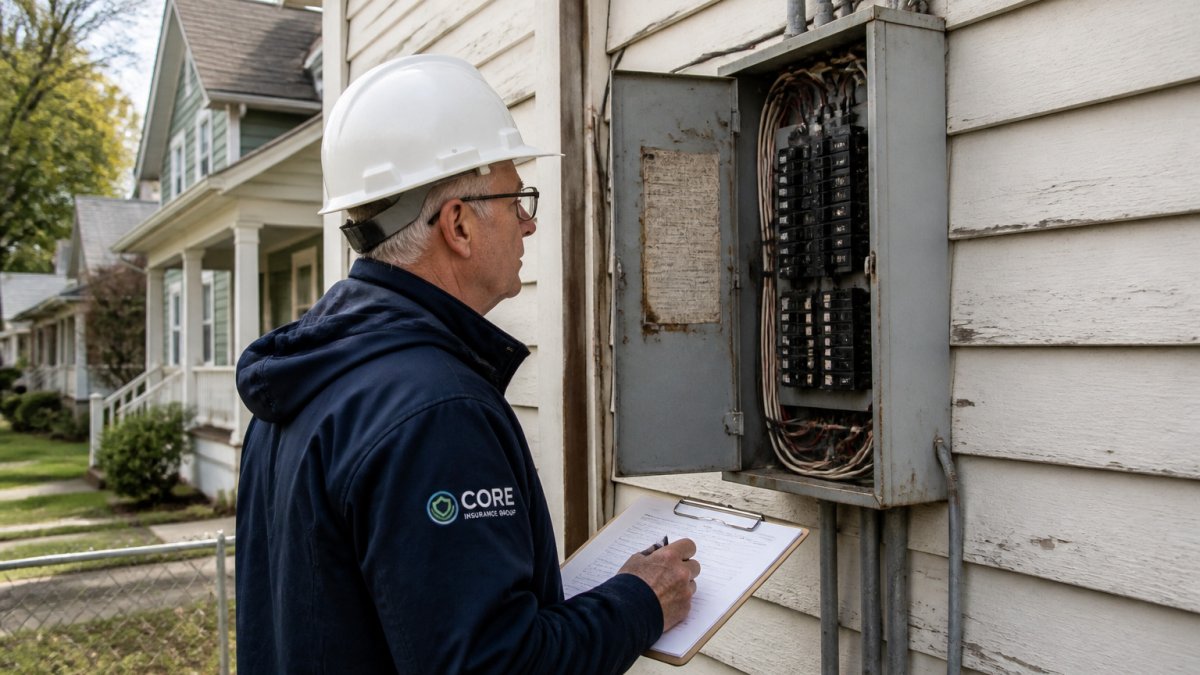
Gather these documents before you apply:
- Recent electrical, plumbing, and roof repair receipts
- Licensed contractor letters confirming updates
- Roof age and material documentation
- Permit records for major renovations
- Photos of the home's exterior, attic, and utility areas
Clear access to the attic, basement, and electrical panel also helps. A little preparation can prevent delays or a conditional approval that comes with costly requirements.
Requesting Your Quote for an Older Home
Start by collecting the details an underwriter will ask for: the year the home was built, updates to major systems, roof age, and any prior claims.
Compare at least a few options before you decide. You can get fast home insurance quotes online in minutes and see how the coverage terms differ.
Frequently Asked Questions
Why do insurers refuse to cover older homes? Insurers often decline older homes because aging electrical, plumbing, and roofing systems increase the chance of a costly claim.
What is a FAIR Plan? A FAIR Plan is a state-backed insurance option for homeowners who cannot get coverage in the standard market.
Should I choose replacement cost or actual cash value? Replacement cost usually provides better protection for an older home because it pays to rebuild without depreciation.
Frequently Asked Questions
What are the alternatives to standard homeowners insurance for an older home?
When a standard insurer declines an older home, the main alternatives are a state FAIR Plan, a surplus lines policy written by a specialty carrier, and a dwelling fire policy that covers the structure against fire and certain named perils. Each option usually has narrower coverage than a standard HO-3 policy, and premiums and availability vary by state and property.
Can you insure a home that is more than 100 years old?
Yes, but the path is usually through a non-standard market rather than a mainstream carrier. Many underwriters ask for updated electrical, plumbing and roof information and may require an inspection before binding. Older homes with documented upgrades, such as modern wiring or a recently replaced roof, are often easier to place. Keeping records of renovations makes the submission stronger.
What is a surplus lines policy for homeowners insurance?
A surplus lines policy is written by an insurer that is not licensed in the state where the property sits, so it is not covered by the state guaranty fund if the carrier fails. These carriers accept risks that admitted carriers decline, including many older homes. Because the coverage is less regulated, reading the policy exclusions and claims terms carefully is important before you buy.
Why do the replacement cost and actual cash value terms matter for an older home?
Replacement cost pays to rebuild or repair using current materials and labor, while actual cash value subtracts depreciation, which can be substantial for an older house. For a home with original plaster, old wiring or a century-old roof, the gap between the two can be large. Check whether a policy offers replacement cost on the dwelling and understand any conditions attached to it.

Want this checked against your own policy?
We compare 100+ carriers and tell you what actually changes.