
What Happens If You Get Caught Without Insurance in Oregon
Last Updated: November 4, 2026
Quick Summary
Driving without insurance in Oregon is a violation, and a citation can bring court fines, costs, and possible DMV action against your license or registration. Penalties depend on whether you had coverage at the stop, whether this is a repeat violation, and how quickly you respond to the citation. The first step is to read the citation carefully and confirm your coverage dates.
- Oregon law requires drivers to carry auto liability insurance.
- A lapse in coverage differs from failing to carry proof of insurance.
- Check the effective dates of your policy in writing with your insurer.
- Respond to the court named on the citation before the deadline printed on it.
- Court fines and DMV actions are separate, so resolving the ticket may not restore driving privileges.
Table of Contents
- What Oregon Requires for Auto Insurance Coverage
- What Counts as Driving Without Insurance in Oregon
- What to Do Immediately After Getting Cited Without Insurance
- Fines, Court Costs and License or Registration Consequences
- How the Oregon Six-Month Insurance Rule and SR-22 Filings Work
- Being in a Crash Without Insurance but Not at Fault
- Reinstating Your Driving and Registration Privileges
- Your Next Step to Get Covered and Stay Legal
- Frequently Asked Questions
What Oregon Requires for Auto Insurance Coverage
Oregon law requires drivers to carry auto liability insurance. Liability coverage pays for injuries and property damage you cause to other people in a crash.
Oregon's minimum requirements are set by state law. Check the current limits with the Oregon Department of Transportation driver and motor vehicle services before you buy a policy, because the amounts can change.
Here is what the minimum covers:
- Bodily injury liability: Pays for injuries you cause to other people
- Property damage liability: Pays for damage you cause to someone else's property
- Proof of coverage: You must be able to show proof of insurance when asked
Liability coverage protects other people. It does not pay for your own car. If you want that protection, you will need to ask about additional coverage types.
What Counts as Driving Without Insurance in Oregon
Driving without insurance is not the same as failing to carry proof of insurance. These are two separate problems, and they carry different consequences.
A lapse in coverage means your policy is not active.
Failing to carry proof means your policy may be active, but you cannot show it when an officer asks. This is often easier to fix.
Oregon drivers also need to understand the difference between being uninsured and being underinsured.
What to Do Immediately After Getting Cited Without Insurance
A citation for driving without insurance is not the same as a conviction. The steps below walk through the practical sequence, checking the citation, confirming your coverage status, gathering documents, contacting the court, and meeting deadlines, without assuming that buying a policy after the stop will make the citation disappear.
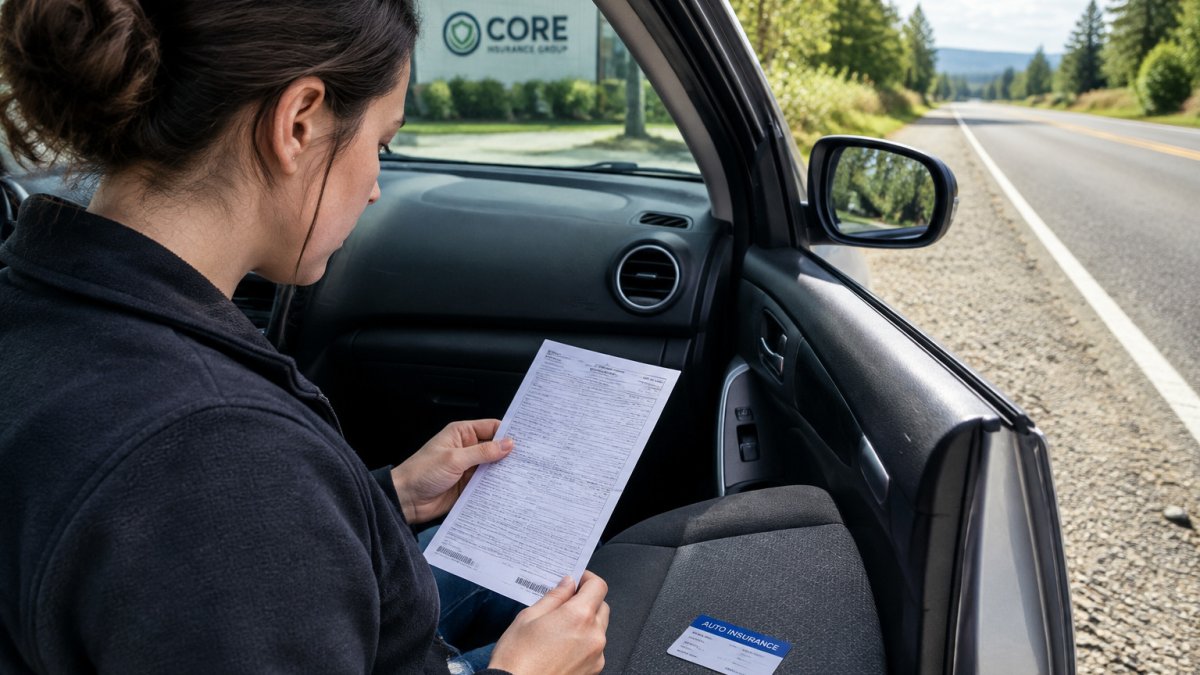
Step 1: Read the citation line by line
Look at what the officer actually wrote. Citations generally identify the violation, the date and time of the stop, the court that will handle the matter, and a response deadline. Note three things in particular:
- The exact violation listed. A citation for failure to provide proof of insurance is a different charge from driving uninsured, and they are handled differently.
- The court and case number. The court named on the citation, not the DMV, is where you respond to the charge itself.
- The response date. This is usually printed on the citation. Missing it can trigger a default or additional penalties, so calendar it immediately.
Step 2: Confirm whether you actually had coverage on the date of the stop
Call your insurer or agent and ask for the effective dates of your policy and whether it was active on the date shown on the citation. Ask for the answer in writing, a declarations page, a certificate of insurance, or an email confirming coverage dates.
Watch out: Do not assume that reinstating a policy today proves you were covered on the date of the stop. Insurers report effective dates accurately, and a court will look at the actual coverage period, not the date you restarted the policy.
Step 3: Gather the right documents
The documents that help depend on which situation applies to you:
- If you had coverage but no proof at the stop: collect your insurance card, declarations page, and proof of premium payment covering the stop date.
- If your coverage had lapsed: collect the cancellation or lapse notice, the reinstatement date, and any payment records showing when coverage restarted.
- If you had no coverage at all: gather what you can showing the current policy you have since obtained, and be prepared to explain the gap honestly.
Keep copies for yourself and bring originals to court if you appear in person.
Step 4: Contact the court before the deadline
Call the court listed on the citation and ask two questions: what resolution options exist for this specific charge, and what documentation the court wants to see. Court practices vary, so confirm with the court what resolution options exist for your charge. If the court offers a pre-trial diversion or documentation-review process, ask what the requirements are and get them in writing.
Step 5: Meet the deadline, and keep records
Respond by the date on the citation, whether that means appearing, submitting documents, or paying. Keep a copy of everything you send and note who you spoke with and when. If you cannot resolve the matter before the deadline, contact the court to ask for an extension rather than letting the date pass.
What not to do
- Do not ignore the citation and hope it goes away; unpaid or unanswered citations can lead to a license suspension and additional court consequences.
- Do not buy a policy solely to "show" the court and then cancel it, a cancellation can create a new lapse and new problems.
- Do not sign anything from the other party in a crash or from a collections agent without understanding what you are agreeing to.
If you are unsure which situation applies to you, a conversation with your insurer or agent about your coverage dates is the fastest way to find out before your court date.
Fines, Court Costs and License or Registration Consequences
Penalties for driving without insurance can come from several sources and depend on the facts of each case. They come from three separate sources, the court that handles the citation, the DMV's administrative rules, and the practical consequences of driving without coverage, and which ones apply to you depends on the facts of your case. The sections below separate those sources so you can see what is likely, what is possible, and what is automatic.
The court side: fines and costs
The court handling your citation sets the fine based on the charge, your record, and the circumstances. Court costs and assessments are typically added on top of the fine, and the total is what you actually owe. Because the amounts are set by statute and adjusted over time, confirm the current figures with the court named on your citation or the Oregon Judicial Department rather than relying on a number you saw online.
The DMV side: license and registration actions
The DMV's administrative consequences are separate from the court's criminal or traffic penalties. They can include:
- License suspension may follow certain violations or a failure to maintain required coverage.
- Registration action may follow when a vehicle is shown to be uninsured.
- Reinstatement requirements generally involve clearing the reason for the suspension and showing current proof of coverage.
These actions attach to your driving record and vehicle record, not to the citation itself, which is why resolving the ticket in court does not always restore your driving privileges. Confirm your status directly with the Oregon DMV before you drive.
Towing and impoundment
A vehicle found being driven without insurance may be towed or impounded depending on the circumstances. Whether that happens depends on the officer, the location, and local policy, it is a possibility, not an automatic outcome of every stop. If your vehicle is towed, you will typically need to show proof of coverage and pay towing and storage costs before releasing it.
How the consequences stack by scenario
| Scenario | Likely court outcome | Possible DMV action | Practical exposure |
|---|---|---|---|
| Coverage active, no proof at stop | Documentation review often resolves the charge | Usually none if coverage is verified | Time and court costs |
| Short lapse, coverage since reinstated | Fine and costs possible; documentation helps | Possible proof-of-responsibility filing requirement | Reinstatement steps and filing period |
| No coverage at time of stop | Fine and costs likely | License and/or registration action possible | Reinstatement, filing requirement, higher premiums |
| Repeat violation | Higher fine range and costs | Suspension more likely | Longer filing period and reinstatement burden |
This table is a general guide, not a prediction. The court and the DMV each apply their own rules to your specific record.
SR-22 and proof of financial responsibility
An SR-22 is a certificate your insurer files with the state to confirm you carry the required coverage. Oregon may require an SR-22 after certain violations or a lapse in coverage. Confirm the current filing period with the Oregon DMV proof of insurance requirements, because the length depends on the reason for the filing. If your policy cancels during the SR-22 period, the insurer notifies the state and the requirement can restart.
What actually drives the outcome
Three factors tend to matter most: whether you had coverage on the date of the stop, whether this is a first or repeat violation, and how quickly you respond to the citation and any DMV notice. Confirming your coverage dates early, gathering documents, and contacting the court before the deadline are sensible steps. If you are unsure where you stand, check your driving record and vehicle registration status with the DMV before your court date so you know whether a separate administrative issue is waiting.
How the Oregon Six-Month Insurance Rule and SR-22 Filings Work
Some drivers must file an SR-22, which is a certificate of financial responsibility. Your insurer files it with the state to show you carry the required coverage.
Core Insurance Group can explain how an SR-22 filing works and how long it may need to stay in place. Check the current rules with the Oregon DMV proof of insurance requirements for the exact filing period.
Keeping your policy active without a gap is the simplest way to avoid these requirements.
Being in a Crash Without Insurance but Not at Fault
Being in a crash without insurance can create serious problems, even if the other driver caused it. Without coverage, you may have to pay your own repairs and medical bills out of pocket.
If you were not at fault, you may still have options. Report the crash to the police, gather names and contact details, and take photos of the scene. Talk to an attorney or claims professional about your rights.
Do not assume the other driver will pay. Get advice before you sign anything.
Reinstating Your Driving and Registration Privileges
If your license or registration was suspended, you must usually clear the reason for the suspension before you can drive again. This often means showing proof of current coverage and paying any required fees.
The steps depend on why the suspension happened. Contact the Oregon DMV for the exact reinstatement process. A current policy is generally what meets reinstatement requirements, and you can contact Core Insurance Group for a quote.
Your Next Step to Get Covered and Stay Legal
If you are driving without insurance in Oregon right now, do not wait. Contact Core Insurance Group to review your options and get covered as soon as possible. Contact us to talk through your policy options and what they cover.
We recommend starting with a review of your current coverage.
Get a quote from Core Insurance Group today and protect yourself on the road.
Frequently Asked Questions
What happens if I get caught driving without insurance in Oregon?
A driver stopped without proof of insurance can be cited, and court costs may apply. Consequences such as license or registration action depend on the case and on whether the driver later shows proof of coverage. Drivers who receive a citation should respond by the date listed on it and gather their insurance documents right away.
What is the six-month rule in Oregon?
Because requirements depend on the circumstances, review the current Oregon Department of Transportation Driver and Motor Vehicle Services guidance or speak with a licensed insurance agent.
Do police know if you are driving without insurance in Oregon?
Keeping a current insurance card or electronic proof in the vehicle and confirming with your carrier that your policy is active are simple steps to take before a stop.
What should I do if I am in a car accident without insurance and I am not at fault?
Report the crash to police, exchange information with the other driver, and document the scene with photos. Consider speaking with an attorney about your options, and keep records of all medical bills and vehicle repair estimates.

Want this checked against your own policy?
We compare 100+ carriers and tell you what actually changes.